Who it's for
For anyone who'd rather a friend got a quiet email than nobody noticed for days.
Nobody knew for two years
For people who live alone
In the newsIn January 2006, council officers forced open a flat in Wood Green, north London, over unpaid rent. Joyce Vincent, 38, had died there around December 2003. The television was still on, and wrapped Christmas presents lay around her. Everyone had assumed someone else was in touch with her.
Source
Mark is 41 and lives alone in a flat in Leeds. At eleven on a Friday night he slips getting out of the shower and breaks his hip. His phone is on the kitchen counter, out of reach. Nobody expects to hear from him until he's back at work on Monday.
Still Here doesn't count his sleep hours. From nine on Saturday morning it counts the time his phone has sat untouched. At five it shows a warning on the phone, which Mark can't reach. At six, his friend Sam gets an email: Mark's phone has been locked since Friday night. Sam has a spare key, and Mark is in hospital that evening instead of being found on Monday, or later.
Set it up: a limit of 8 to 12 hours, sleep hours on, and a contact who lives nearby or has a key.
A fall in the kitchen, and a phone across the room
For older parents, and the children who worry about them
In the newsIn 2024, 76,020 people in Japan died alone at home, according to the first national count by Japan's National Police Agency; three in four were 65 or older. Some 4,500 older people were not found for more than a month.
Source
Margaret is 79 and lives alone outside Bristol. Her daughter Helen is two hours away in London. Every morning Margaret checks the weather on her phone. On a Tuesday in February she does that at a quarter to eight, puts the phone down in the bedroom, and falls in the kitchen. She can't get up.
Lying on the floor for hours after a fall is dangerous in itself. Helen set Margaret's limit to six hours when they installed Still Here together. At ten to two the phone shows Margaret a warning she can't reach. At ten to three, Helen gets an email. She rings Margaret's neighbour, who has a key. Without it, Helen might have started worrying on Thursday, after two unanswered calls.
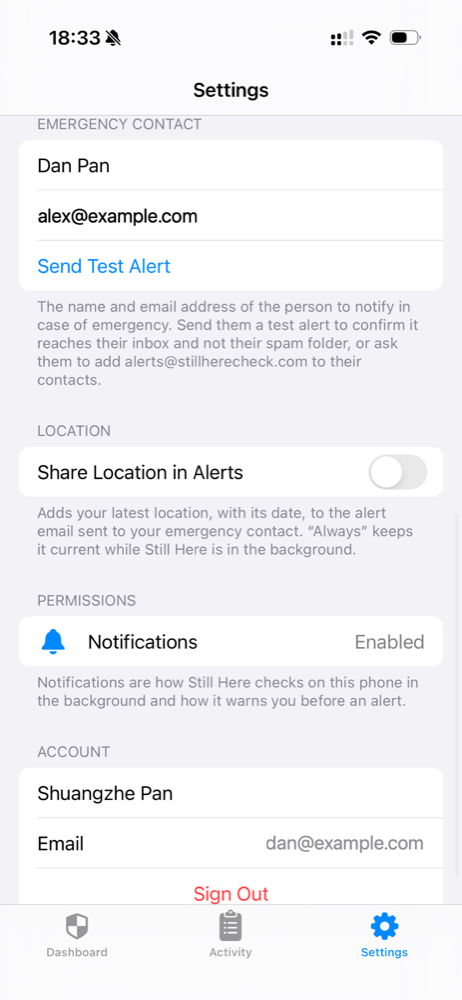
Set it up: together, on her iPhone, with a limit of 6 to 8 hours and sleep hours that match her routine. Then press Send Test Alert so you both know what an alert looks like.
He told no one where he was going
For anyone who hikes, runs, travels or works alone
In the newsIn April 2003, Aron Ralston was hiking alone in Blue John Canyon, Utah, when a boulder pinned his arm against the canyon wall. He had told no one where he was going. After five days he freed himself by amputating his own arm, the story later told in the film 127 Hours.
Source
Jake is 34 and leaves for a solo day hike in the Cascades at seven on a Saturday. He takes a photo from the ridge at 12:40. Half an hour later he slips on scree and breaks his ankle. His phone has no signal; he can't call anyone, and nobody knows which trail he took.
Before leaving, Jake set both Still Here limits to six hours. With no signal, his phone stops answering the server, and at 6:40 that evening his partner Priya gets an email: phone unreachable since 12:40, last seen near the ridge, with a map link. She calls the county sheriff, and a search starts that night from his last known position, not days later from nowhere.
Set it up: before you leave, set both limits to the longest you'd go without touching your phone, five or six hours, and turn on location. Set them back when you're home. Deep in the backcountry, carry a satellite messenger too.
When you can't press the button
For people with a condition that could leave them unable to call for help
In the newsAbout one in five adults with active epilepsy in the US lives alone, a higher share than adults without it, according to national survey data published by the CDC. A common fear is having a seizure, getting hurt, and nobody knowing.
Source
Daniel is 29, has epilepsy, and lives alone in Toronto. On a Sunday he finishes breakfast at 10:20 and leaves his phone on the kitchen counter. Twenty minutes later he has a seizure in the bathroom, hits his head on the way down, and can't get up. An SOS button only helps if you can reach it and press it.
Still Here needs nothing from him. His limit is five hours. At 3:20 the phone shows a warning nobody sees. At 4:20 his sister Ana, who lives across town, gets an email saying his phone hasn't been used since 10:20. She's at his door within the hour.
Set it up: a limit close to the longest you'd usually go without your phone during the day, and a contact who is nearby and able to act. It works in hours, not minutes, and doesn't detect seizures or any medical event, so keep any seizure monitor or alert device you use. This is one more layer.
A job offer near the border
For anyone travelling somewhere riskier than usual
In the newsIn January 2025, Chinese actor Wang Xing flew to Bangkok for what he thought was a film audition. He was driven 500 km north to Mae Sot and taken by boat across the river into a scam compound in Myanmar. He was rescued four days later, after his girlfriend's plea for help went viral. The UN estimates at least 120,000 people in Myanmar may be held in scam operations like it.
Source ·
UN estimate
Emma is 27, from Manchester, and backpacking through northern Thailand. In Chiang Mai a friendly stranger offers her well-paid work at a hotel near the border. On Tuesday morning she gets into a van. At 1:40 that afternoon her phone is taken from her and switched off.
Before the trip, Emma set Still Here's unreachable limit to six hours. At 7:40 that evening her sister Lucy gets an email: Emma's phone has been unreachable since 1:40, last seen on the road to Mae Sot, with a map link. Lucy calls the embassy and the police that night with a time and a place. Still Here can't rescue anyone. It makes sure someone starts asking on the first evening, with something concrete to tell the people who can.
Set it up: before you go, turn on location and shorten the unreachable limit to a few hours if you're usually online. An "unreachable" email can simply mean no signal, and it says so. If someone keeps your phone switched on and uses it, Still Here sees normal use, so register with your embassy and keep travel insurance too.
The news is real. The people in the stories are illustrations, and their names are made up.
Questions
Does it drain the battery?
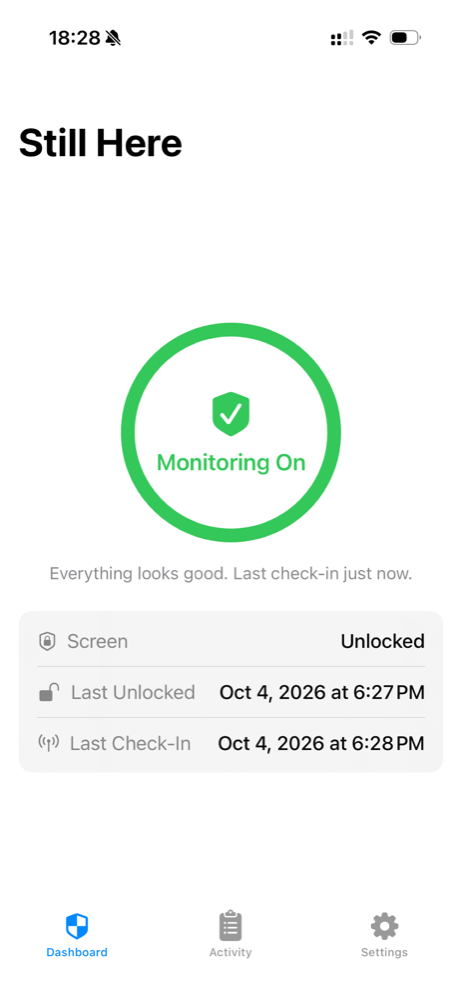
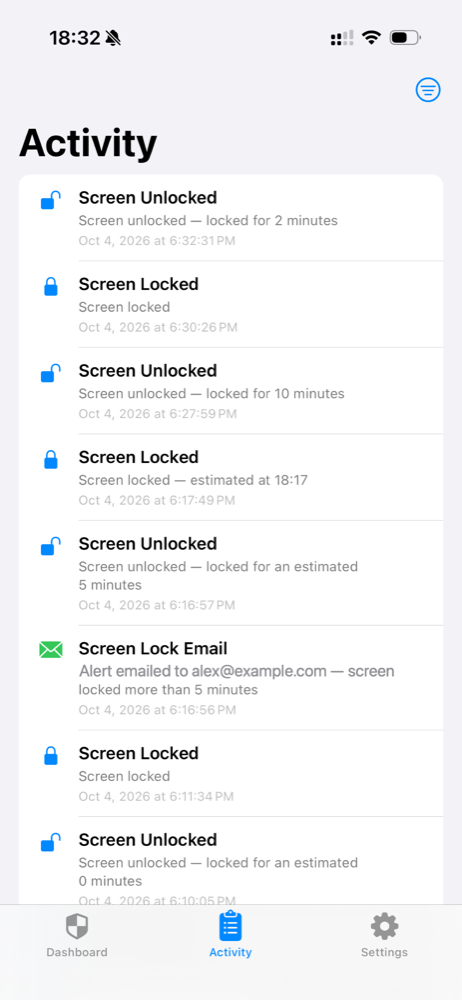
No. The app isn't running in the background. Your phone reports lock and unlock events, and a server does the watching. Most check-ins are silent notifications that iOS handles in a fraction of a second.
What if my phone dies or has no signal?
Then the server stops hearing from it. After the "unreachable" limit you set (one day by default), your contact gets an email saying the phone can't be reached, with when it was last seen and its last known battery level.
What does my contact actually receive?
One plain email per alert, from alerts@stillherecheck.com: your name, how long the phone has been inactive or unreachable, when it was last seen, and — only if you've turned it on — where it last was. It ends with "this often just means they're resting or busy; send a message or call."
Will it bother me at night?
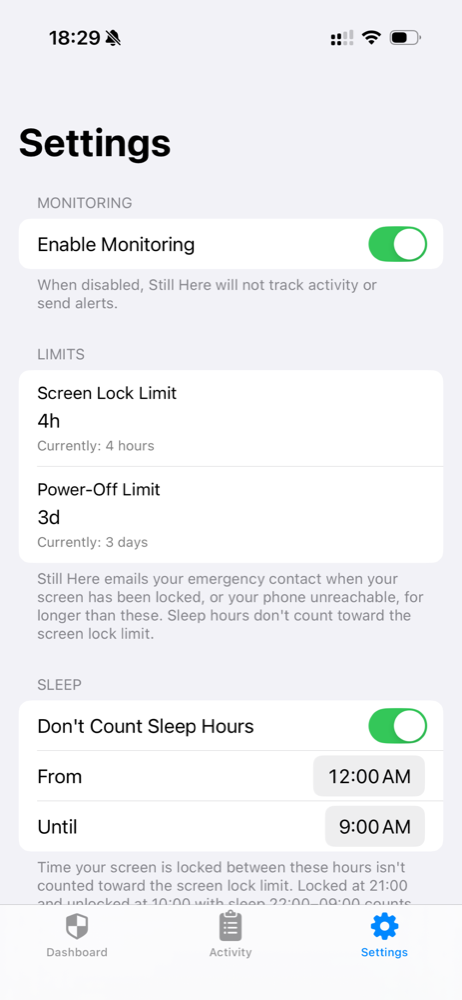
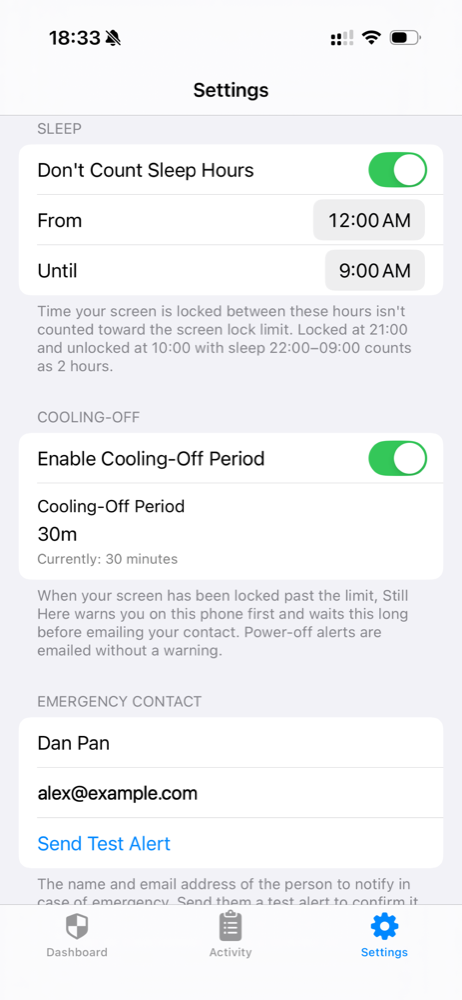
No. Set your sleep hours (22:00–09:00 by default) and time locked inside them doesn't count toward the limit, and no check-ins are sent while you sleep.
Do you track my location?
Only if you turn on "Share Location in Alerts", and then only the most recent position is kept so an alert can say where the phone last was. Off means off. There are no ads, no analytics and no tracking of any kind. Privacy policy.
Why does a free app exist?
It was built by one person who wanted it for the people he worries about, and it costs almost nothing to run. If that ever changes, the app will say so first.